

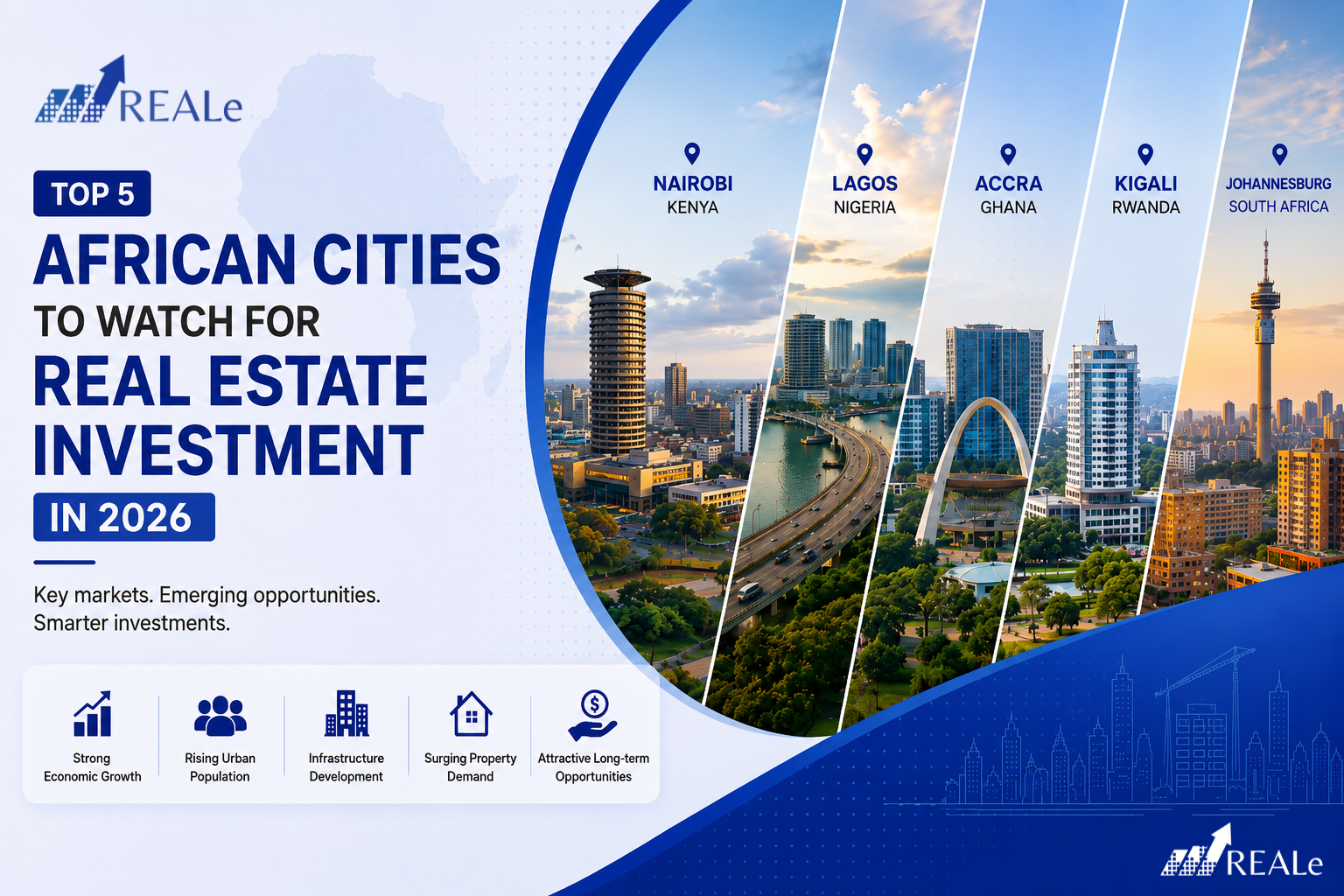
African real estate continues to attract attention from developers, institutional investors and private buyers looking beyond established global markets. Rapid urbanisation and population growth are increasing the need for homes, workplaces and community infrastructure, while transport investment is opening new districts and connecting satellite towns to economic centres.
The opportunity is broader than population growth alone. Expanding business districts, technology-driven economic activity and a growing demand for modern residential and commercial properties are changing how many African cities develop. Housing shortages create a substantial need, but each city has its own affordability, financing, regulatory and supply constraints. Sound decisions therefore depend on local research rather than continent-wide assumptions.
Africa’s leading cities are becoming important long-term property markets as urban growth, infrastructure and modern business activity reshape where people live and work.
This 2026 overview builds on the five markets identified by Estate Intel in its 2025 analysis. It keeps the focus on Nairobi, Lagos, Accra, Kigali and Johannesburg while treating the earlier article’s forecasts and performance figures as historical context—not as current 2026 facts or guaranteed indicators of future returns.
Why Investors Are Watching African Real Estate in 2026
Urban migration continues to concentrate households, employment and services in major metropolitan areas. As the middle class expands in different parts of the continent, demand is diversifying across premium housing, practical middle-income homes, rentals near employment centres and well-managed mixed-use communities. Yet demand does not automatically translate into a viable project: purchasing power, mortgage availability and infrastructure capacity remain decisive.
Roads, public transport, utilities, ports and digital connectivity can make previously peripheral locations more usable. At the same time, housing shortages coexist with commercial growth in finance, technology, professional services, hospitality and retail. This combination creates possible openings in residential projects, logistics facilities and mixed-use developments that bring housing, work and services closer together.
Property technology is also improving how opportunities are assessed and operated. Digital inventory, CRM, online booking workflows, payment tracking and analytics give developers a clearer view of demand and project performance. Investors should still avoid guaranteed-return claims: construction costs, currency movements, regulation, vacancy, infrastructure delivery and local economic conditions can materially change an outcome.
1. Nairobi, Kenya — East Africa’s Business & Technology Hub
Nairobi is a regional commercial centre and one of Africa’s best-known technology and startup hubs. International businesses, local enterprises and a large professional workforce support demand for housing and business space. Westlands combines offices, retail, hospitality and residential activity, while Upper Hill remains an important commercial district. Their appeal depends on building quality, access, parking, amenities and the balance between new supply and occupier demand.
Residential Opportunities
Kilimani and parts of Westlands attract residents who value access to offices, shops and services, while Karen offers a lower-density residential environment. Demand for modern apartments can favour projects with reliable utilities, security, practical layouts and professional management. Around the metropolitan area, satellite towns may offer lower entry costs and room for housing growth, but investors must examine commuting patterns, infrastructure delivery and genuine end-user affordability.
Commercial Opportunities
Nairobi’s business and technology ecosystem supports offices, coworking space, retail and serviced accommodation. The strongest opportunities are usually asset-specific: flexible space, efficient buildings and locations near clients and skilled employees may compete better than undifferentiated offices. Commercial feasibility should include vacancy, tenant quality, lease terms and the volume of competing space.
Why Nairobi Remains Attractive
Nairobi combines regional connectivity, a deep business network and varied submarkets. Its technology sector can support demand from professionals and growing firms, while satellite-town expansion creates a different residential proposition. This diversity keeps Nairobi relevant in 2026, although careful site selection and affordability analysis remain essential.
2. Lagos, Nigeria — Population, Infrastructure & Massive Property Demand
Lagos is Nigeria’s commercial centre and one of the continent’s largest urban economies. Its very large population produces deep housing demand across income levels, alongside requirements for offices, retail, warehouses and industrial facilities. Current 2026 market research continues to highlight Lagos as a major African real estate market, but its scale should not obscure the practical challenges of affordability, infrastructure, construction costs and access.
Residential Opportunities
Ikoyi, Victoria Island and Lekki serve premium segments with apartments and gated developments. Mainland markets such as Yaba, Surulere and Ikeja address different price points and can benefit from proximity to established jobs and services. Investors should distinguish visible demand from financially qualified demand and assess service charges, flooding exposure, power and transport access before selecting a site.
Commercial & Mixed-Use Growth
Lagos supports activity across finance, technology, trade, entertainment and consumer services. That economic breadth creates potential for commercial, industrial and mixed-use development. Projects combining residential space with retail, offices or community services may respond to long journeys and fragmented infrastructure, provided the tenant mix and operating model are realistic.
Emerging Growth Corridors
The Lekki-Epe corridor illustrates how transport, industrial investment and large infrastructure projects can redirect growth. Infrastructure-led appreciation is possible when access and economic activity improve, but delivery timelines and development costs must be independently verified. Land title, planning approval, drainage and utilities deserve the same attention as future growth narratives.
3. Accra, Ghana — Stable Market with Growing Residential Demand
Accra functions as a regional business hub and attracts multinational organisations, professionals and expatriates. East Legon, Cantonments and Airport Residential Area are established premium residential locations, with apartments, townhouses and detached homes serving higher-income demand. Spintex and Adenta provide different opportunities for middle-income housing and projects aimed at a broader local market.
Grade A commercial space can appeal to organisations seeking modern specifications, dependable services and accessible locations. However, investors must evaluate supply and vacancy risks carefully. A recognised business address does not guarantee occupancy, particularly where new office supply competes for a limited pool of premium tenants. Residential projects likewise need price points that reflect local income, financing conditions and management costs.
4. Kigali, Rwanda — Planned Growth & Sustainable Development
Kigali is distinguished by planned urban development and a strong emphasis on clean, orderly and sustainable growth. Its expanding business and conference activity supports demand for modern accommodation, hospitality and selected commercial property. Residential development ranges from higher-end homes to projects seeking to address the need for practical urban housing.
Green City Kigali is an example of sustainability-focused development, bringing attention to resource efficiency, greener neighbourhood planning and affordable housing goals. For developers, sustainable design can improve long-term usability and respond to policy direction, but certification, construction costs and buyer affordability must be incorporated into feasibility work.
Planned infrastructure and consistent urban governance can support long-term property demand by giving developers clearer frameworks and improving access to services. They do not remove market risk. Kigali is smaller than several cities in this comparison, so project scale, target customers and the depth of tenant demand require particularly careful assessment.
5. Johannesburg, South Africa — A Mature African Property Market
Johannesburg is a major financial and commercial centre with established property institutions, professional services and market data. Sandton remains a prominent corporate node, while Rosebank blends offices, apartments, hotels, retail and transport access. The city offers commercial office and residential opportunities alongside an important logistics and industrial property market serving Gauteng’s large economic base.
Its established property infrastructure gives investors more comparable evidence than is available in some emerging markets, but maturity does not mean uniform performance. Office conditions can vary by building quality and node; residential prospects can change from one neighbourhood to the next; and logistics demand depends on access, security and tenant requirements. Investors should evaluate individual submarkets rather than treating Johannesburg as a single market.
Comparing the Five Cities
| City | Key Strength | Property Opportunities | Investor Considerations |
|---|---|---|---|
| Nairobi | Technology and regional business hub | Residential, office, retail | Location, supply and affordability |
| Lagos | Massive population and economic scale | Residential, mixed-use, industrial | Infrastructure, affordability and development costs |
| Accra | Regional stability and expatriate demand | Residential and commercial | Supply and vacancy levels |
| Kigali | Planned and sustainable urban development | Residential, commercial, hospitality | Market size and project selection |
| Johannesburg | Mature financial and property ecosystem | Office, residential, logistics | Submarket performance and economic conditions |
What Investors Should Evaluate Before Investing
Location & Demand
Study the immediate catchment, target customer, competing projects and realistic price point. Citywide growth can coexist with oversupply in a particular neighbourhood or property type.
Regulations and Property Ownership Rules
Ownership structures, leasehold rules, title registration, planning approvals and foreign-investment requirements differ across countries. Local legal advice is essential before land or property is acquired.
Infrastructure
Verify existing roads, drainage, water, power, internet and public transport separately from proposed infrastructure. A future project can improve a location, but delays can change development timing and cost.
Rental Demand
Assess achievable rents, vacancy, tenant turnover and lease terms using comparable properties. Headline asking rents do not necessarily show the income an asset will consistently produce.
Developer Track Record
Review completed projects, delivery history, construction quality, approvals and after-sales service. For off-plan purchases, examine contractual protections and how buyer funds are managed.
Property Management Costs
Security, utilities, maintenance, insurance, service charges and reserve funds affect net performance. Modern facilities add value only when operating costs remain suitable for the target occupants.
Currency & Economic Risk
Exchange-rate movements, inflation, interest rates and access to finance can affect construction budgets and investment outcomes. Revenues and liabilities denominated in different currencies need careful modelling.
Sustainability
Energy efficiency, water management, heat resilience, drainage and durable materials can reduce operational pressure and meet changing expectations. Sustainability claims should be supported by measurable design and operating standards.
Every investor should perform independent financial and legal due diligence. This article is a market overview, not financial, legal or investment advice, and no city or property can offer a guaranteed return.
Technology Is Changing African Real Estate
As portfolios and sales networks expand, modern property companies increasingly use real estate ERP and CRM systems to replace disconnected spreadsheets and manual registers. Digital inventory management can show available units, while booking management and payment tracking help teams follow transactions from reservation through collection.
Associate and channel partner management supports wider sales networks. Project development tracking links plans and site progress to management reporting, while material management helps teams monitor procurement and usage. Analytics dashboards can bring sales, inventory, collections and development information together so leaders can identify exceptions earlier. Technology improves visibility, but the quality of data and the discipline of the operating process still determine its value.
How REALe ERP Supports Growing Real Estate Businesses
Developers operating across growing markets need centralised systems as projects, customers and sales networks become more complex. Platforms like REALe ERP can help developers centralize growing real estate operations as projects, customers and sales networks become more complex.
REALe ERP connects booking management and property or unit inventory with customer management, CRM and lead management. It also supports associate management, payment monitoring, accounts, project development and material management. Reports and analytics give authorised teams a shared operational view, while role-based access helps control which users can see and manage different areas.
These capabilities do not replace local market judgment or investment due diligence. They provide a structured way to manage the operational detail behind multiple developments, customer relationships and transactions—especially when manual processes become difficult to coordinate.
Frequently Asked Questions
Which African cities are promising for real estate investment in 2026?
Nairobi, Lagos, Accra, Kigali and Johannesburg each merit research in 2026 because they combine urban demand with distinct business, infrastructure or development strengths. “Promising” does not mean guaranteed: the appropriate market depends on an investor’s strategy, risk tolerance, target segment and due diligence.
Why is Nairobi attractive to property investors?
Nairobi is a regional business and technology hub with demand from companies, professionals and households. Westlands, Upper Hill, Kilimani, Karen and satellite towns offer different residential and commercial propositions, making location-specific analysis vital.
Is Lagos a good real estate market for investors?
Lagos has enormous economic scale and substantial demand for housing, commercial, industrial and mixed-use property. Whether a project is suitable depends on title, infrastructure, affordability, development cost, financing and the specific submarket.
Why is Kigali gaining attention from property developers?
Kigali’s planned urban growth, governance framework, business and conference activity, and emphasis on sustainable development attract attention. Green City Kigali also demonstrates the city’s sustainability ambitions, although market size and project selection need careful evaluation.
What should investors check before investing in African real estate?
Investors should examine title and ownership rules, planning approvals, location, end-user demand, infrastructure, achievable rents, vacancy, developer history, management costs, financing, currency exposure and construction quality with qualified local advisers.
How is technology changing real estate development in Africa?
ERP, CRM, digital inventory, booking workflows, payment monitoring, project tracking, material management and analytics are helping property businesses centralise information. Better visibility can support faster decisions and more consistent customer service across complex operations.
Conclusion
Nairobi, Lagos, Accra, Kigali and Johannesburg represent different types of opportunity. Nairobi combines technology and regional business activity; Lagos offers exceptional urban scale; Accra serves professional, expatriate and middle-income demand; Kigali emphasises planned and sustainable growth; and Johannesburg provides a mature, varied property ecosystem.
None is guaranteed to be the best market. Successful investment depends on location, market demand, regulations, infrastructure, financing, project quality and rigorous due diligence. As developers take on more complex projects and operations, modern real estate technology can help them manage inventory, customers, payments, partners, development activity and reporting through connected processes.