

Why Modern Housing Societies Need a Society Management App
Managing a residential society is no longer limited to maintaining a register, collecting monthly maintenance charges and displaying notices on a community notice board.
Today's housing societies handle residents, tenants, visitors, maintenance payments, complaints, security staff, vendors, assets, expenses, notices, committee activities and financial records every day.
When these operations are managed separately using paper registers, spreadsheets, phone calls and messaging groups, information quickly becomes fragmented and difficult to track.
A modern Society Management App brings these activities into one connected digital platform where residents, committee members and administrators can manage everyday society operations more efficiently.
A Society Management App replaces scattered registers, spreadsheets and manual communication with one centralized platform for residents, maintenance, visitors, complaints, notices, staff, assets and community operations.
What Is a Society Management App?
A Society Management App is a digital platform designed to help residential communities manage administrative, financial and communication-related activities from one system.
It can be used by apartment associations, housing societies, gated communities, resident welfare associations and society management committees to organize their daily operations.
Instead of maintaining multiple disconnected records, a society management platform creates a centralized digital environment where important information can be accessed and updated whenever required.
- Resident and member management
- Maintenance and society charges
- Visitor management
- Complaint tracking
- Notices and announcements
- Committee management
- Staff management
- Asset tracking
- Revenue and expenses
- Community polls
- Reports and operational insights
Why Manual Society Management Becomes Difficult
Small residential communities may initially manage their operations through notebooks, spreadsheets and messaging groups. However, as the number of flats, residents and daily activities increases, these methods become difficult to maintain.
1. Information Becomes Scattered
Resident details may exist in one spreadsheet, maintenance payments in another, visitor records at the security gate and complaints inside messaging groups.
Finding the correct information later can become time-consuming.
2. Payment Tracking Requires Manual Follow-Up
Society committees frequently need to track who has paid maintenance charges, which payments are still pending and how much revenue has been collected.
Without a centralized system, payment reconciliation and follow-ups can require significant manual effort.
3. Complaints Can Get Lost
Residents may report issues through phone calls, personal messages or group chats. Without a structured complaint-management workflow, it becomes difficult to determine which issue is open, in progress or resolved.
4. Communication Becomes Unorganized
Important notices about water supply, maintenance work, meetings, security updates or community activities may become difficult to locate inside busy messaging groups.
5. Committee Members Lack Real-Time Visibility
Society management committees need visibility into revenue, expenses, complaints, residents, maintenance collections and operational activities. Manual records make this information harder to review quickly.
How a Society Management App Solves These Problems
A dedicated Housing Society Management App creates a centralized workflow for managing everyday activities.
Committee members can access structured information while residents receive faster communication and easier access to society services.
1. Resident and Member Management
Maintaining accurate resident information is one of the most important parts of society administration.
A society management platform can maintain records for:
- Flat owners
- Tenants
- Contact details
- Flat numbers
- Resident roles
- Committee members
This creates a centralized resident directory and reduces dependency on separate spreadsheets or physical records.
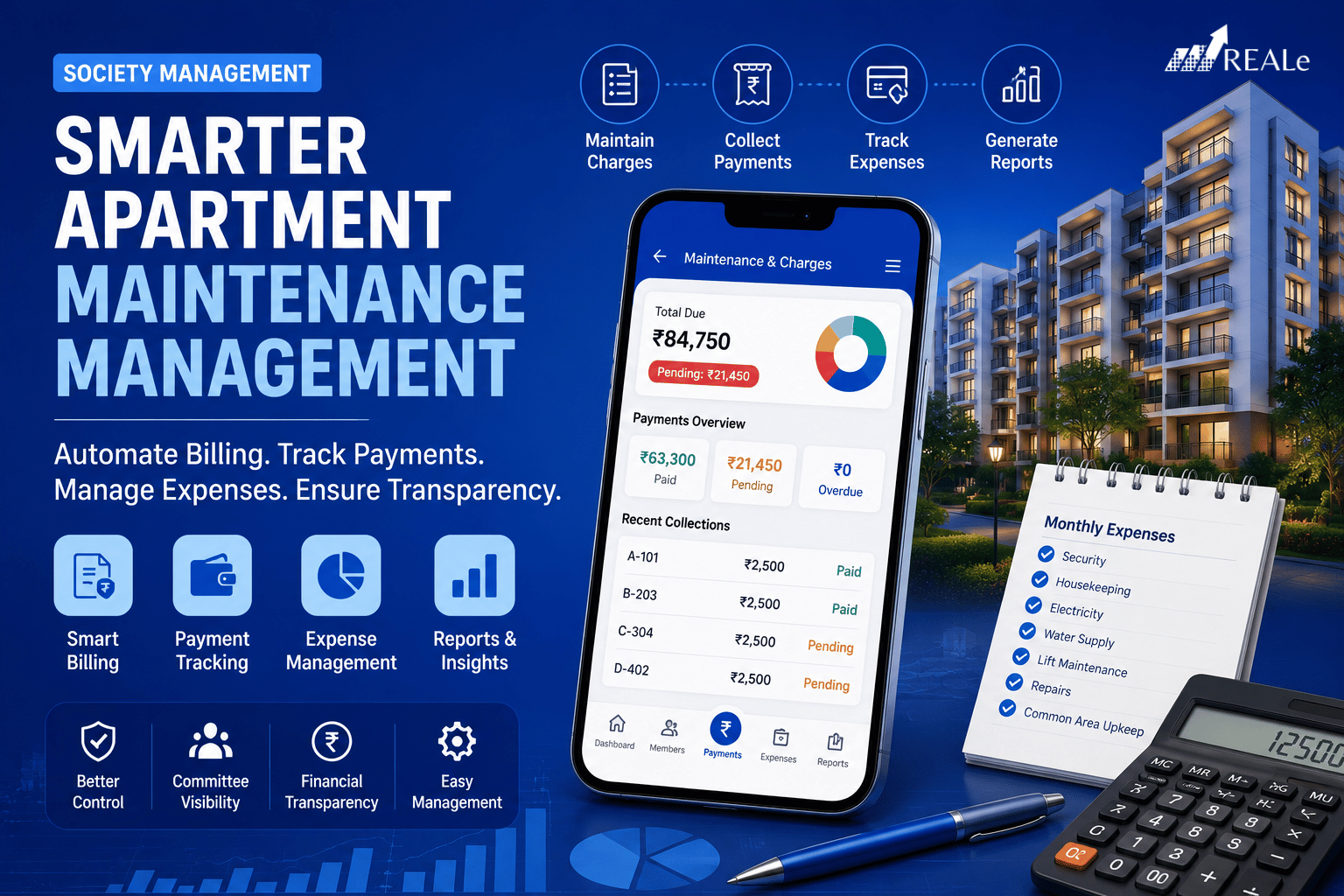
2. Maintenance and Society Charges
Maintenance collection is one of the most important financial operations handled by residential societies.
A digital system can help societies organize different types of recurring or one-time charges such as:
- Monthly maintenance charges
- Water charges
- Parking charges
- Facility charges
- Other society-related collections
Administrators can view payment status and distinguish between paid and pending collections more easily.
Digital society platforms increasingly combine billing, payment visibility and accounting-related workflows to reduce manual reconciliation. This type of centralized payment management is also becoming a key feature across modern society-management platforms. :contentReference[oaicite:1]{index=1}
3. Visitor Management
Visitor management is another important part of residential society operations.
Instead of relying entirely on handwritten gate registers, digital visitor management enables visitor information to be recorded in a structured manner.
Depending on the workflow, residents or administrators may be able to review visitor details and approve or reject access requests.
- Visitor name
- Contact number
- Purpose of visit
- Flat being visited
- Visit time
- Approval status
Structured visitor-management workflows are now a common expectation in apartment-management platforms because they improve coordination between residents, management teams and security personnel. :contentReference[oaicite:2]{index=2}
4. Complaint Management
Common residential complaints may include water leakage, lift problems, electrical issues, parking concerns, common-area maintenance or security problems.
A Society Management App allows these complaints to be recorded and organized through defined statuses.
- Open
- In Progress
- Resolved
This gives both residents and management teams better visibility into issue resolution and reduces the possibility of requests being forgotten.
5. Notices and Announcements
Residential communities regularly publish important information about:
- Society meetings
- Water supply interruptions
- Lift maintenance
- Security alerts
- Community events
- Parking instructions
- Maintenance updates
A dedicated notice section keeps these updates organized instead of allowing important information to disappear inside long messaging conversations.
6. Committee Management
Managing committee information digitally helps residents understand who is responsible for different areas of society administration.
The platform may maintain details for roles such as:
- Chairman
- Secretary
- Treasurer
- Other committee members
This improves transparency and creates clearer communication channels within the community.
7. Staff Management
Housing societies often depend on security personnel, housekeeping staff, electricians, plumbers and other operational employees.
A centralized staff-management section can maintain information such as:
- Staff name
- Designation
- Contact details
- Shift information
- Service responsibilities
Maintaining these records digitally makes everyday administration simpler for society committees.
8. Society Asset Management
Residential societies own and maintain several shared assets that require regular monitoring.
These may include:
- Generators
- Water pumps
- Lifts
- Electrical equipment
- Security equipment
- Common-area infrastructure
A digital asset-management section makes it easier to maintain asset records, locations and maintenance status.
9. Revenue and Expense Management
Financial transparency is important for maintaining trust between residents and management committees.
A society management platform can provide clearer visibility into both income and expenditure.
Revenue Tracking
Society revenue may come from:
- Maintenance collections
- Parking charges
- Facility charges
- Other society collections
Expense Tracking
Common society expenses may include:
- Electricity bills
- Security staff salaries
- Lift maintenance
- Repairs
- Housekeeping
- Facility maintenance
Centralizing income and expenses helps management committees understand the financial position of the society more clearly.
10. Community Polls and Resident Participation
Housing societies regularly need resident opinions before making decisions involving shared facilities or community rules.
Digital polls can simplify voting for questions such as:
- Should CCTV coverage be expanded?
- Should the community hall be renovated?
- Should maintenance charges be revised?
- Should new parking rules be introduced?
Digital participation creates a faster and more transparent way to gather community feedback.
Benefits of Using Society Management Software
Moving from manual administration to a digital society-management system can offer several operational advantages.
| Traditional Process | Digital Society Management |
|---|---|
| Paper-based resident records | Centralized member database |
| Manual maintenance tracking | Digital payment status visibility |
| Gate visitor registers | Structured visitor management |
| Complaints through calls or messages | Trackable complaint workflow |
| Notice-board communication | Digital notices and announcements |
| Scattered financial records | Revenue and expense visibility |
| Manual community voting | Digital polls |
| Separate asset registers | Centralized asset management |
Benefits for Society Management Committees
Committee members are responsible for maintaining the financial and operational health of a residential society.
A digital society platform can help committees achieve:
- Better operational visibility
- Reduced administrative effort
- Centralized society records
- Improved payment tracking
- More transparent expense management
- Faster complaint resolution
- Better communication with residents
- Structured reporting
Benefits for Residents
Residents also benefit when society information and services become easier to access.
- View important notices
- Track society-related communication
- Raise complaints
- Participate in community polls
- Access maintenance information
- Manage visitor-related activities
- Stay connected with the society committee
Mobile-first access to services such as bills, visitor approvals and complaints is increasingly becoming a standard expectation from apartment management software. :contentReference[oaicite:3]{index=3}
Why Centralized Data Matters for Housing Societies
One of the biggest advantages of digital society management is centralized information.
When members, complaints, payments, visitors, staff, assets and financial activity are maintained inside the same ecosystem, administrators can access information faster and maintain more consistent records.
This becomes increasingly important as residential societies grow in size and operational complexity.
Society Management App vs WhatsApp and Excel
WhatsApp and spreadsheets are useful general-purpose tools, but they were not specifically designed for managing residential communities.
Messaging groups are effective for conversations, but important notices, complaints and payment information can become difficult to organize.
Spreadsheets can store data, but they often require manual updates and reconciliation.
Dedicated Society Management Software combines structured workflows, centralized records and operational visibility within one system.
Introducing REALe Society Management
REALe Society Management is designed to bring everyday residential society operations into one connected platform.
The application provides modules for managing important areas of society administration including:
- Maintenance & Charges
- Committee
- Members
- Complaints
- Staff
- Assets
- Reports
- Polls
- Expenses
- Revenue
- Visitors
- Notices and Announcements
The goal is simple: reduce fragmented administration and give society management teams a clearer way to manage their community.
Less administration. Better society management. REALe brings residents, operations, finances and communication together in one connected digital platform.
How to Choose the Right Society Management App
Before selecting software for a housing society, management committees should evaluate whether the platform matches their actual operational requirements.
Ease of Use
Residents and committee members should be able to understand the application without extensive training.
Resident Management
The platform should provide an organized system for managing owners, tenants and member information.
Financial Visibility
Maintenance collections, revenue and expenses should be easy to monitor.
Visitor Management
The system should provide a structured way to manage visitors and entry approvals.
Complaint Tracking
Complaints should have clear statuses so residents and administrators can understand their progress.
Mobile Accessibility
Since residents increasingly expect services directly from their phones, mobile access is an important consideration when evaluating society management software. :contentReference[oaicite:4]{index=4}
Frequently Asked Questions
What is a Society Management App?
A Society Management App is software that helps housing societies manage residents, maintenance charges, visitors, complaints, notices, staff, assets, financial records and community activities through a centralized digital platform.
Who can use Society Management Software?
Society management software can be used by apartment associations, resident welfare associations, cooperative housing societies, gated communities, committee members, administrators and residents.
Can a Society Management App manage maintenance payments?
Yes. Depending on the platform, society management software can help maintain charge structures, track collections and show paid or pending maintenance status.
Can residents raise complaints through a Society App?
Yes. A complaint-management module can allow issues to be recorded and tracked through statuses such as Open, In Progress and Resolved.
How does digital visitor management help housing societies?
Digital visitor management keeps visitor information in a structured format and can support approval workflows between residents, administrators and security teams.
Is Society Management Software better than Excel?
Excel is useful for storing data, but dedicated society software provides specialized workflows for residents, payments, visitors, complaints, notices, assets, staff and financial management within a unified system.
Does REALe Society Management support multiple society operations?
REALe Society Management includes modules for members, committees, maintenance and charges, complaints, staff, assets, reports, polls, expenses, revenue, visitors and notices within one application.
The Future of Digital Society Management
Residential communities are becoming larger and increasingly dependent on digital communication.
As expectations around transparency, convenience and security continue to rise, more societies are likely to move away from fragmented manual systems toward specialized digital platforms.
The next generation of housing society management will increasingly focus on mobile accessibility, automation, centralized records, better reporting and faster interaction between residents and society administrators.
Conclusion
Managing a modern residential society involves much more than collecting maintenance charges and maintaining resident records.
Visitors, complaints, notices, staff, community assets, expenses, revenue and resident communication all require continuous coordination.
A Society Management App brings these activities into one structured digital environment, helping committees reduce administrative effort while giving residents a more convenient way to interact with their community.
With modules covering maintenance, members, visitors, complaints, finances, staff, assets, polls and notices, REALe Society Management provides a connected foundation for smarter residential community administration.