

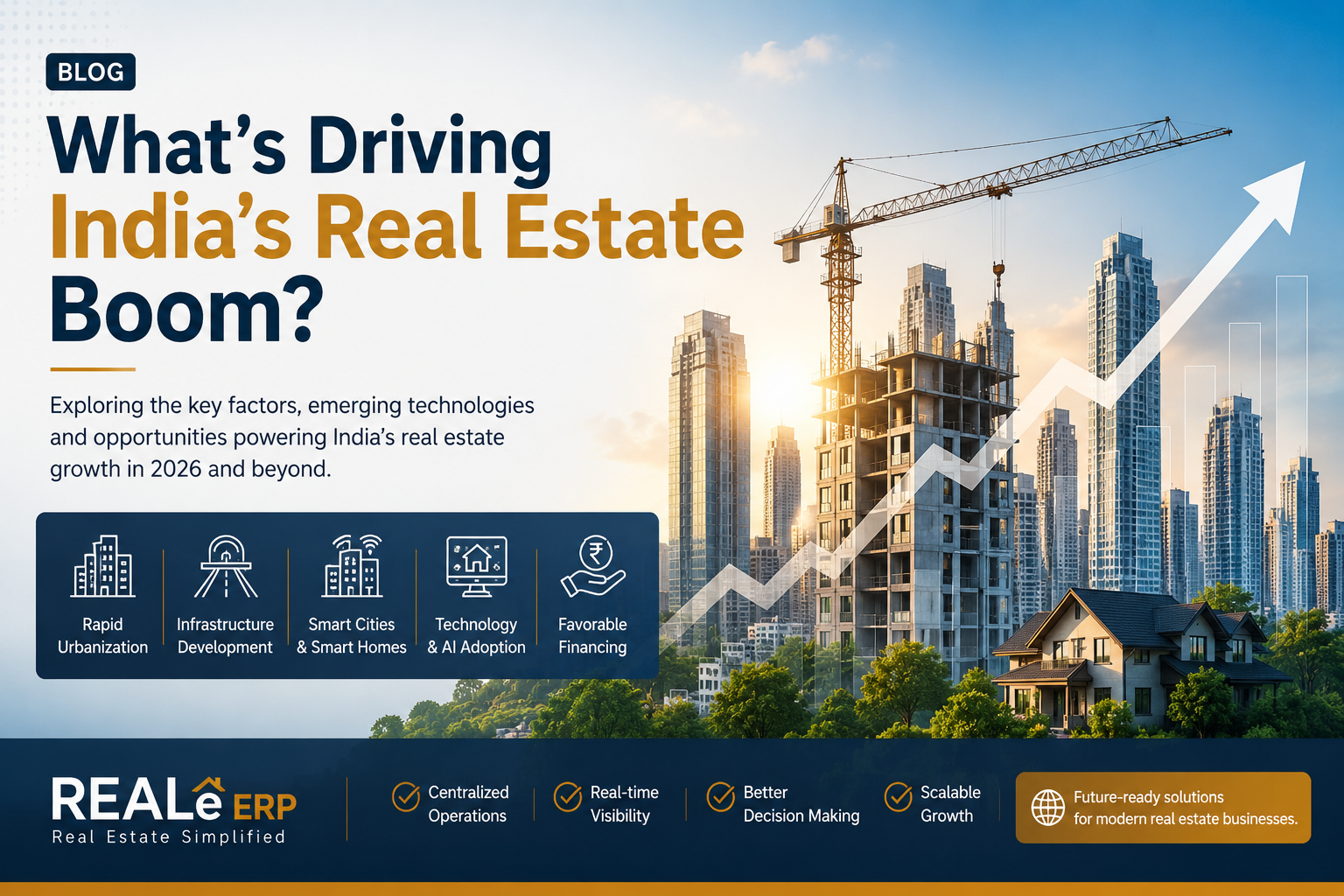
India's Real Estate Sector Is Entering a New Era of Growth
India's real estate market has evolved dramatically over the past decade. What was once driven primarily by location and pricing is now influenced by technology, infrastructure development, smart city initiatives, digital customer experiences, and data-driven business operations. Today, buyers expect transparency, developers seek operational efficiency, and investors demand long-term value before making purchasing decisions.
This transformation has accelerated demand for modern business solutions such as Real Estate ERP Software. Developers are no longer relying on disconnected spreadsheets and manual processes. Instead, they are embracing centralized platforms that streamline project management, bookings, customer relationships, inventory, payments, and reporting.
The combination of strong economic growth, government initiatives, improved financing options, and rapid urbanization has created an ideal environment for the Indian real estate sector. As a result, organizations investing in digital transformation and modern Real Estate ERP Solutions are better positioned to manage growth while delivering exceptional customer experiences.
India's real estate boom is no longer driven only by construction—it is powered by infrastructure, technology, customer expectations, and intelligent business management.
Rapid Urbanization Is Creating New Opportunities
One of the biggest contributors to India's real estate expansion is urbanization. Every year, millions of people move toward cities in search of better employment, education, healthcare, and lifestyle opportunities. This migration continues to increase demand for residential apartments, commercial spaces, integrated townships, and mixed-use developments.
As cities expand, developers must manage larger inventories, multiple construction sites, growing customer databases, and complex financial operations. Managing these activities manually becomes increasingly difficult, making a modern Real Estate ERP System essential for sustainable business growth.
The Rise of Tier-2 and Tier-3 Cities
While metropolitan cities continue to attract investment, Tier-2 and Tier-3 cities have emerged as significant growth destinations. Improved highways, expressways, metro connectivity, industrial corridors, and government-backed infrastructure projects have transformed these cities into attractive real estate markets.
Cities such as Indore, Lucknow, Mohali, Jaipur, Bhubaneswar, Surat, and Coimbatore are witnessing increasing demand for residential and commercial developments. Lower land costs, improved infrastructure, and expanding employment opportunities make these markets highly attractive for both developers and investors.
Managing projects across multiple cities requires centralized visibility, standardized workflows, and real-time reporting. This is where Cloud-Based Real Estate ERP platforms provide a significant competitive advantage.
Infrastructure Development Is Fueling Growth
Massive investments in highways, airports, metro rail systems, logistics parks, industrial zones, and smart infrastructure are reshaping India's property landscape. Infrastructure improvements not only increase property values but also create entirely new residential and commercial investment opportunities.
Government initiatives including PM Gati Shakti, Smart Cities Mission, affordable housing schemes, and industrial development corridors continue to strengthen the country's real estate ecosystem.
- Expansion of national highways and expressways
- Improved metro rail connectivity
- Growth of industrial corridors
- Development of smart cities
- Affordable housing initiatives
- Commercial and logistics infrastructure expansion
These developments are encouraging developers to launch larger and more sophisticated projects that require intelligent operational management.
Smart Cities and Smart Homes Are Changing Buyer Expectations
Modern buyers are looking beyond square footage. They expect connected communities, advanced security, energy-efficient homes, green spaces, digital amenities, and convenient access to healthcare, education, transportation, and entertainment.
Smart homes equipped with IoT devices, automated lighting, energy management, surveillance systems, and digital access controls are becoming increasingly popular among homebuyers.
Technology Is Transforming the Real Estate Experience
Technology has become one of the biggest growth drivers for India's real estate industry. Buyers now expect digital experiences before making investment decisions, while developers are adopting advanced technologies to improve efficiency, transparency, and customer engagement.
Virtual property tours, AI-powered recommendations, digital documentation, online booking systems, and mobile applications have simplified the property buying journey. Instead of visiting multiple locations physically, customers can now explore projects, compare amenities, review floor plans, and make informed decisions remotely.
For developers, these technologies improve lead conversion, shorten sales cycles, and strengthen customer relationships while reducing operational costs.
Artificial Intelligence Is Becoming a Game Changer
Artificial Intelligence (AI) is reshaping how developers, brokers, and real estate companies operate. AI can analyze customer preferences, property values, market trends, and buying behavior to deliver personalized property recommendations.
Chatbots provide instant customer support, predictive analytics improve investment planning, and automated follow-up systems help sales teams convert more leads into successful bookings.
As AI adoption continues to increase, businesses using intelligent automation will have a clear competitive advantage over organizations that still depend on manual processes.
Why Modern Developers Need Real Estate ERP Software
As projects become larger and customer expectations continue to rise, developers require more than traditional accounting software or spreadsheets. They need a centralized platform capable of managing every aspect of the business from a single dashboard.
A modern Real Estate ERP Software connects sales, CRM, inventory, finance, HR, material management, construction progress, customer support, and reporting into one integrated solution.
Instead of working with disconnected systems, teams can collaborate using real-time information, enabling faster decision-making and greater operational transparency.
Benefits of Implementing a Real Estate ERP System
- Centralized property inventory management
- Real-time booking and payment tracking
- Integrated CRM and lead management
- Digital document management
- Construction and project monitoring
- HR and employee management
- Material procurement and inventory tracking
- Advanced dashboards and business analytics
- Role-based security and access control
- Cloud accessibility from anywhere
These capabilities allow developers to improve productivity, reduce manual work, eliminate operational bottlenecks, and deliver a better customer experience.
How REALe ERP Supports India's Growing Real Estate Industry
REALe ERP has been developed specifically for builders, developers, township projects, and real estate organizations that require a complete business management platform. Unlike generic ERP solutions, REALe ERP focuses entirely on the unique requirements of the real estate industry.
The platform currently includes five integrated business modules:
- Core Module – Booking, inventory, customer and payment management.
- CRM Module – Lead management, follow-ups, customer communication and sales tracking.
- HR Module – Employee management, attendance and workforce operations.
- Material Module – Procurement, stock management and vendor tracking.
- Development Module – Project execution, task monitoring and construction progress tracking.
As a modern Cloud-Based Real Estate ERP, REALe ERP enables organizations to manage operations from anywhere while maintaining complete visibility across departments.
The Future of India's Real Estate Market
India's real estate sector is expected to continue growing over the coming years, supported by infrastructure development, increasing urbanization, favorable government policies, rising disposable incomes, and continuous technological innovation.
Organizations that embrace digital transformation and invest in scalable Real Estate ERP Systems will be better equipped to handle growing demand, improve operational efficiency, and deliver exceptional customer experiences.
Conclusion
India's real estate boom is being driven by far more than construction activity. Infrastructure expansion, smart cities, digital transformation, AI, cloud technology, and changing customer expectations are creating enormous opportunities for developers and investors alike.
To succeed in this rapidly evolving market, businesses require intelligent, scalable, and integrated business management solutions. Whether you are searching for the Best Real Estate ERP, Best Real Estate ERP Software, Real Estate ERP India, Real Estate ERP Solution, or the Best Real Estate ERP in India, adopting the right technology today will position your organization for long-term success.
REALe ERP empowers developers to streamline operations, improve customer satisfaction, automate workflows, and confidently manage the next generation of real estate projects across India.