

India’s Real Estate Industry Reaches a Major Milestone
India’s real estate industry is becoming more organized, transparent and professionally managed. One of the clearest indicators of this transformation is the rapid increase in RERA-registered real estate agents across the country.
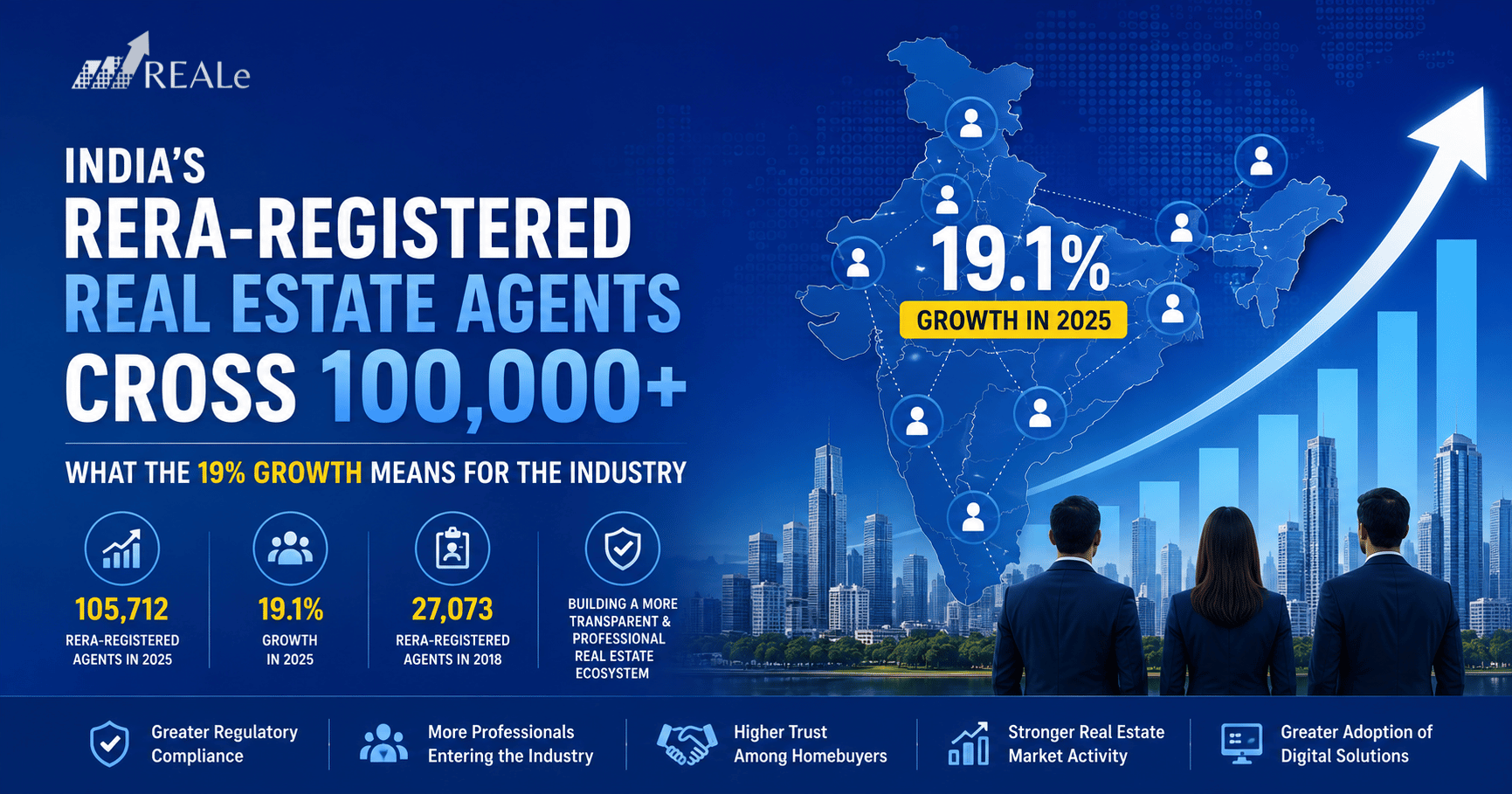
According to research by eXp Realty India, the number of RERA-registered real estate agents in India reached 105,712 in 2025.
The registered agent base recorded 19.1% growth, taking the total number of registered professionals beyond the 100,000 milestone.
This represents a major transformation compared with 2018, when India had approximately 27,073 RERA-registered real estate agents.
The rise from 27,073 registered agents in 2018 to 105,712 in 2025 highlights the rapid formalisation and professional growth of India’s real estate brokerage ecosystem.
RERA-Registered Real Estate Agents in India: Key Numbers
The numbers demonstrate how significantly the registered real estate agent ecosystem has expanded over the past several years.
| Indicator | Figure |
|---|---|
| RERA-Registered Agents in 2018 | 27,073 |
| RERA-Registered Agents in 2025 | 105,712 |
| Latest Reported Growth | 19.1% |
| Major Milestone | 100,000+ Registered Agents |
Why Is the Growth of RERA-Registered Agents Important?
Crossing 100,000 registered agents is more than just an industry statistic. It reflects a broader change in the way property transactions are being conducted across India.
The real estate brokerage market has traditionally included a large network of independent brokers, local property consultants and channel partners.
Increasing RERA participation is helping move this ecosystem towards a more structured and regulated environment.
1. A More Organized Real Estate Market
More professionals entering the registered ecosystem means a larger portion of the brokerage market is operating through formal regulatory structures.
This can help developers, agents and property buyers work within clearer and more transparent processes.
2. Greater Regulatory Awareness
Awareness surrounding RERA has increased significantly since the regulation was introduced.
Real estate professionals are increasingly recognizing the importance of registration, compliance and transparency while participating in property transactions.
3. Professionalisation of Real Estate Sales
Modern real estate agents are no longer simply intermediaries connecting property buyers and sellers.
Today, agents may manage:
- Property enquiries
- Customer requirements
- Lead follow-ups
- Site visits
- Project information
- Property inventory
- Bookings
- Documentation
- Payment coordination
- Developer relationships
As competition increases, agents who provide structured, professional and technology-enabled services can create stronger customer experiences.
What This Growth Means for Homebuyers
Homebuyers are among the biggest beneficiaries of a more organized and regulated property market.
Purchasing a property is often one of the largest financial decisions a person makes. Buyers therefore expect greater transparency and accountability from everyone involved in the transaction.
Easier Identification of Registered Professionals
State RERA portals provide information about registered real estate agents, allowing buyers to perform additional verification before engaging with a property professional.
Greater Accountability
Formal registration provides agents with a regulatory identity, helping create a more structured relationship between property professionals and their customers.
Better Access to Professional Services
A growing professional agent network gives property buyers access to more consultants who can assist with project discovery, site visits, property comparisons and transaction coordination.
What the Growth Means for Real Estate Agents
The increase in registered agents creates significant opportunities, but it also increases competition.
When thousands of professionals compete for the same buyers, projects and markets, agents need better systems and stronger customer relationships to differentiate themselves.
Lead Management Becomes Critical
Real estate leads can come from many different channels, including:
- Property portals
- Developer campaigns
- Social media
- Websites
- Online advertising
- Referrals
- Offline marketing
- Existing customers
Managing these enquiries through spreadsheets, notebooks and messaging applications becomes increasingly difficult as the number of leads grows.
Follow-Ups Can Determine Sales Success
Property purchases rarely happen after a single conversation. Buyers often require multiple interactions before making their final decision.
Agents may need to coordinate:
- Phone calls
- Meetings
- Site visits
- Property recommendations
- Price discussions
- Payment discussions
- Booking follow-ups
A structured follow-up process therefore becomes a major competitive advantage.
What This Means for Real Estate Developers
Developers can also benefit from the expanding network of professional property agents.
Agents and channel partners help developers reach buyers across multiple locations and customer segments.
However, managing hundreds or thousands of associates introduces another operational challenge.
Developers Need Better Associate Management
A developer working with a large channel network may need to manage:
- Associate profiles
- Agent documentation
- Project allocation
- Sales performance
- Bookings
- Brokerage calculations
- Commission payments
- Sales levels
- Communication
Accurate Inventory Information Becomes Essential
Property agents need accurate information about available inventory, pricing, project details and payment plans.
Centralized digital systems can make it easier for developers and sales teams to maintain consistent project information.
Technology Will Accelerate the Transformation
As India's real estate ecosystem grows, technology will become increasingly important for managing the volume of leads, customers, projects and transactions.
Real estate businesses are increasingly adopting digital solutions such as:
- Real estate CRM software
- ERP platforms
- Lead management systems
- Property inventory management
- Digital documentation
- Payment tracking
- Automated reminders
- Reports and analytics
- Mobile applications
Why CRM Is Becoming Essential for Real Estate Agents
A real estate CRM allows agents and sales teams to maintain customer information in a centralized system.
Instead of managing enquiries through disconnected spreadsheets, notebooks and WhatsApp conversations, teams can organize leads according to their sales journey.
| Traditional Process | CRM-Based Process |
|---|---|
| Leads stored in spreadsheets | Centralized lead management |
| Manual follow-up reminders | Structured follow-up tracking |
| Scattered customer information | Complete customer history |
| Limited sales visibility | Stage-wise sales pipeline |
| Manual reporting | Dashboard-based reporting |
Role of ERP Software in a Growing Real Estate Market
While CRM systems focus primarily on customer relationships and sales activities, real estate ERP platforms can connect multiple business operations through one centralized system.
Real estate organizations may need to manage:
- Projects
- Property inventory
- Bookings
- Customers
- Associates
- Payments
- Accounts
- Documents
- Development operations
- Material management
- Reports and analytics
Connecting these processes can give management teams better visibility into their overall operations.
How REALe ERP Supports Modern Real Estate Businesses
REALe ERP is designed to help real estate businesses manage multiple operational workflows through one connected digital platform.
The platform supports areas such as:
- Project management
- Property inventory
- Customer management
- Booking management
- Payment tracking
- Associate management
- CRM and sales
- Development operations
- Material management
- Reports and analytics
For businesses managing growing customer, project and associate networks, centralized information can reduce fragmented workflows and improve operational visibility.
More Agents Mean More Opportunities — and More Competition
Crossing 100,000 RERA-registered agents represents a major expansion of India's professional real estate sales ecosystem.
More registered professionals can mean:
- Greater market coverage
- More opportunities for developers
- More options for property buyers
- Stronger professional networks
- Greater competition among agents
Greater competition also means agents need to provide better customer experiences.
Faster communication, systematic follow-ups, accurate property information and professional service can become increasingly important differentiators.
RERA and the Shift Toward a More Transparent Real Estate Ecosystem
One of the broader goals of RERA is to improve transparency and accountability within India's real estate sector.
The growing number of registered agents indicates that the brokerage side of the market is increasingly becoming part of this structured regulatory ecosystem.
This transformation can support a healthier property market where developers, agents and buyers operate with better access to information and clearer processes.
The Future of Real Estate Agents in India
As India's property market continues to expand, the role of real estate agents is also likely to evolve.
The future real estate professional may combine strong local market knowledge and relationship-building skills with digital capabilities such as:
- CRM-based lead management
- Digital property discovery
- Automated customer communication
- Online documentation
- Data analytics
- Digital marketing
- Mobile sales tools
The next phase of India's real estate brokerage industry will not be defined only by how many agents enter the market, but by how effectively professionals use regulation, data and technology to serve property buyers.
Frequently Asked Questions
How many RERA-registered real estate agents were there in India in 2025?
According to the reported eXp Realty India research, India had 105,712 RERA-registered real estate agents in 2025 .
How much did the number of registered agents grow?
The report states that the registered agent base recorded 19.1% growth in the latest period.
How many RERA-registered agents were there in 2018?
India had approximately 27,073 RERA-registered real estate agents in 2018.
Why is RERA registration important for property agents?
RERA registration places real estate agents within a formal regulatory framework and supports greater transparency and accountability in regulated property transactions.
Why do real estate agents need CRM software?
CRM software helps agents organize leads, customer information, follow-ups, site visits and sales stages through a centralized system.
How can ERP software help real estate developers?
Real estate ERP software can connect project management, inventory, bookings, customers, associates, payments, documentation and reporting through one platform.
Conclusion
Crossing 100,000 RERA-registered real estate agents represents an important milestone for India's property industry.
The increase from approximately 27,073 registered agents in 2018 to 105,712 in 2025 highlights the significant expansion of India's professional real estate brokerage ecosystem.
For agents, the growing market creates new opportunities but also greater competition. For developers, it creates a larger professional channel network. For homebuyers, it reflects the continued movement toward a more organized property marketplace.
As the industry grows, technology will become increasingly important. CRM platforms, digital workflows and integrated solutions such as REALe ERP can help real estate businesses manage larger customer, project and associate networks while reducing dependency on fragmented manual processes.